
Zero To One GTM: A Framework For Diagnosing Org Blind Spots
As well as fit with individuals, whether for career navigation or consulting engagements

Days 35 and 36 of writing daily 1 2
🧐🛠️ What Is This/How We Built This
Back in 2022, Karn and I created a fellowship helping people navigate their careers (especially experienced ICs across tech, or emerging managers).
Then I had a series of facilitators from the first and second cohorts, including Dr. Jocelyn Logan-Friend, who helped co-develop the framework shared below.
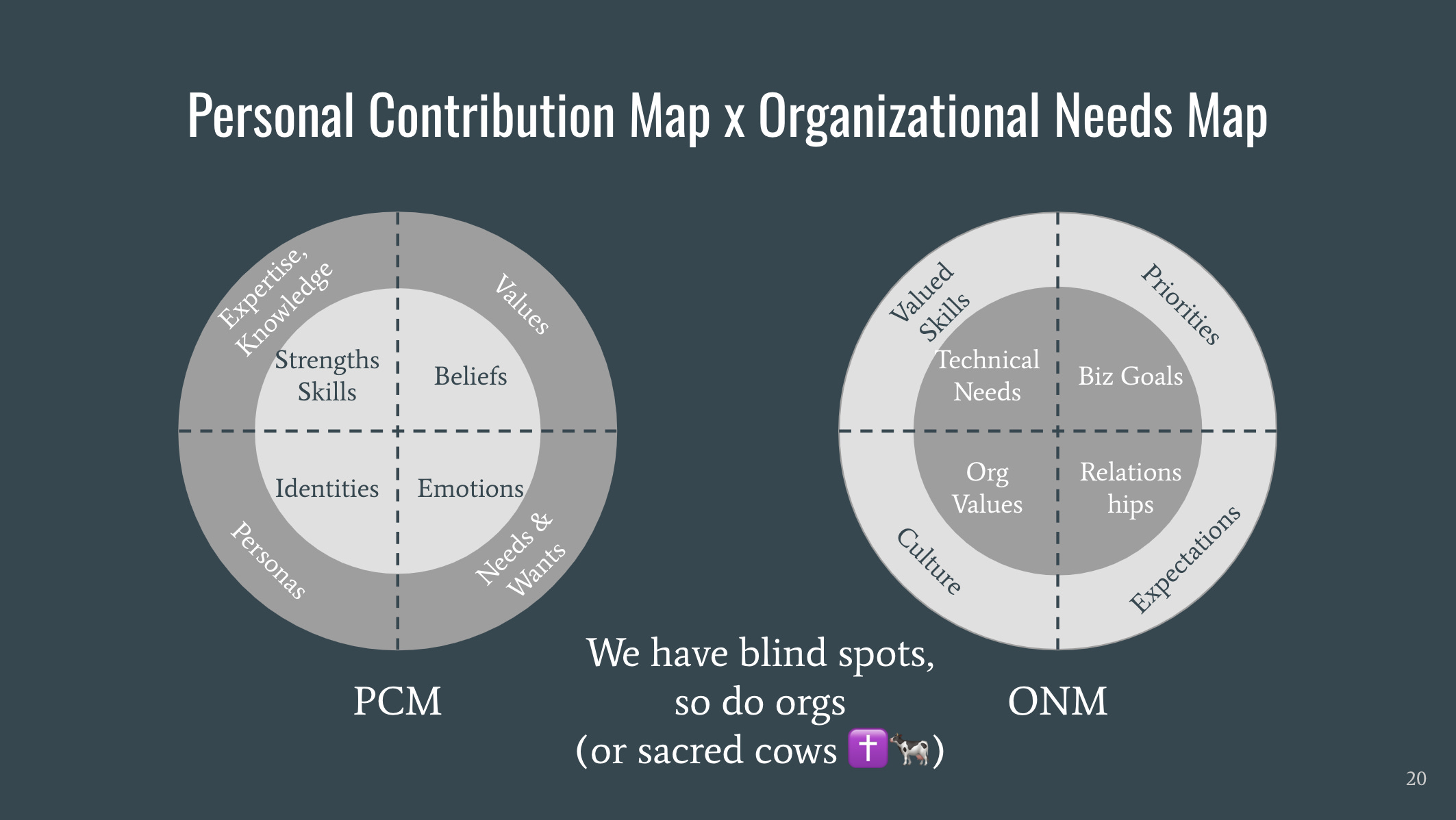
The graphic above was originally intended to help people map their own strengths, empowering and limiting beliefs, and diagnose imposter syndrome manifestations and then contextualize in the organization in which they were operating.
And to find how much convergence/resonance (or divergence/dissonance) there was between their own internal and external and the organization’s explicit skills valued, priorities, culture and expectations (as well as the implicit layer underneath: technical needs, business goals, org values, and relationships.
🙋🏻💎 Why We Think It’s Valuable
The idea was that both individuals and institutions have implicit/hidden behaviors, goals, wants, emotions, etc. (what we manifest is often just the tip of the iceberg).
Every org has: sacred cows and blind spots.
Intentional (and sometimes unintentional) trade-offs about how it’s organized, to align with strategy, product, growth, process, etc.
The more overlap between an individual and institution, the more resonance, the more one can bring their true selves to work.
The less overlap, the more dissonance and challenge to us bringing our true selves to work, and more likelihood of gaslighting, moving expectations/goalposts, challenging relationships, autocratic vs. trust-based relationships and other such challenges driving imposter syndrome.
💁♀️🏎️ Why It’s Relevant: re org agility
I started talking about org readiness/agility for new product development. And this is a really interesting area where I wanted to bring this framework.
In working with different organizations, I’ve come to find this framework really useful as well. As an outsider, it can be more difficult to discern some of the internal behaviors.
But if you’re brought in and really want to make an impact, you can still learn them based on what you observe and what you infer:
How meetings are organized?
How people communicate, the language they use?
How strategic decisions are made?
What motivates people, how they are supported, and how they are held accountable?
This matters for me especially as I've shifted my ICP to larger organizations, and it’s been intriguing to try to tailor my advice or focus in projects around product and GTM. And I’ve already talked about orgs as slime molds and building for aligned autonomy vs. top-down autocracy.
🤹🏻♂️🔑 Three Key Insights:
1) Making explicit the assumptions and context behind an institution’s (and a particular leader’s) interest in a new strategic direction or initiative is super helpful — it helps align on scope, sequence and objectives for any engagement or project.
Looking at a new strategic initiative for the CEO of a large organization? It helps to know how they arrived at the decision, what kind of funding exists, how they plan to incubate and grow it? (as context for what they want your help with)
2) The more you understand—how an institution is structured, how decisions get made, history/precedent (or lack there of), SWOT—the more you can adapt your priorities and framing to really help them.
Looking at helping an organization codify or productize expertise, services, or some other area and support GTM? It helps to know how the org is structured, its current approach connecting marketing and BD-driven lead gen to sales and contracts to delivery and customer experience/service.
3) Whether you explicitly or implicitly consider the framework—biz goals, decisions, values, relationships and talent expertise/strengths (and gaps)—the interplay between explicit objectives/statements and implicit behaviors can illuminate a lot about how to drive new products and initiatives.
Looking to help an organization drive new products to expand impact? It helps to consider individual and team blind spots (e.g., maybe they feel resistant to technology or virtual because they believe the best learning experiences must be facilitated in-person, and unpack the reasons behind the resistance - is it more about skills and worry about failure, or about fundamental beliefs and mindsets?
Conclusion
The framework we've developed over the years has proven to be a versatile tool for navigating the complex interplay between individuals and organizations. It serves not only as a mirror for personal growth and career development but also as a lens through which we can understand and optimize organizational dynamics.
As we continue to apply this framework in various contexts—from career counseling to product development and organizational strategy—we're constantly reminded of its power to unveil hidden truths and drive meaningful change. The key lies in recognizing that both individuals and institutions are multifaceted entities with visible and invisible layers. By mapping these layers and finding areas of alignment or misalignment, we can foster environments where authenticity thrives, innovation flourishes, and both personal and organizational goals are achieved harmoniously.
Moving forward, I encourage leaders, consultants, and individuals to adopt this holistic approach in their work. By considering the full spectrum of explicit and implicit factors at play, we can create more resilient strategies, develop more impactful products, and build more inclusive, high-performing organizations.
My last was an unpublished post just for my personal board of advisors; sorry not sorry. Then I didn’t get to this yesterday, although I’d outlined the idea behind the content of this post as two posts over the weekend: one on introducing this framework/context, why it matters, and then going deeper on applying it to the idea of org agility. Actually it might be all three posts. I’ll re-read it tomorrow and see if I have anything else to add on the idea of org agility and how to diagnose its readiness (org-wide, and within certain divisions) to tackle innovation, and of what kind/to what extent.
The good thing about momentum is it keeps you busy.
The bad thing about momentum is it keeps you busy.
Right now, the time it takes me to write daily and try to synthesize, create frameworks, share stories and insights that I find valuable is to much.
So we’ll see how this continues, if I can streamline it while still making it (what I hope is) valuable and insightful.